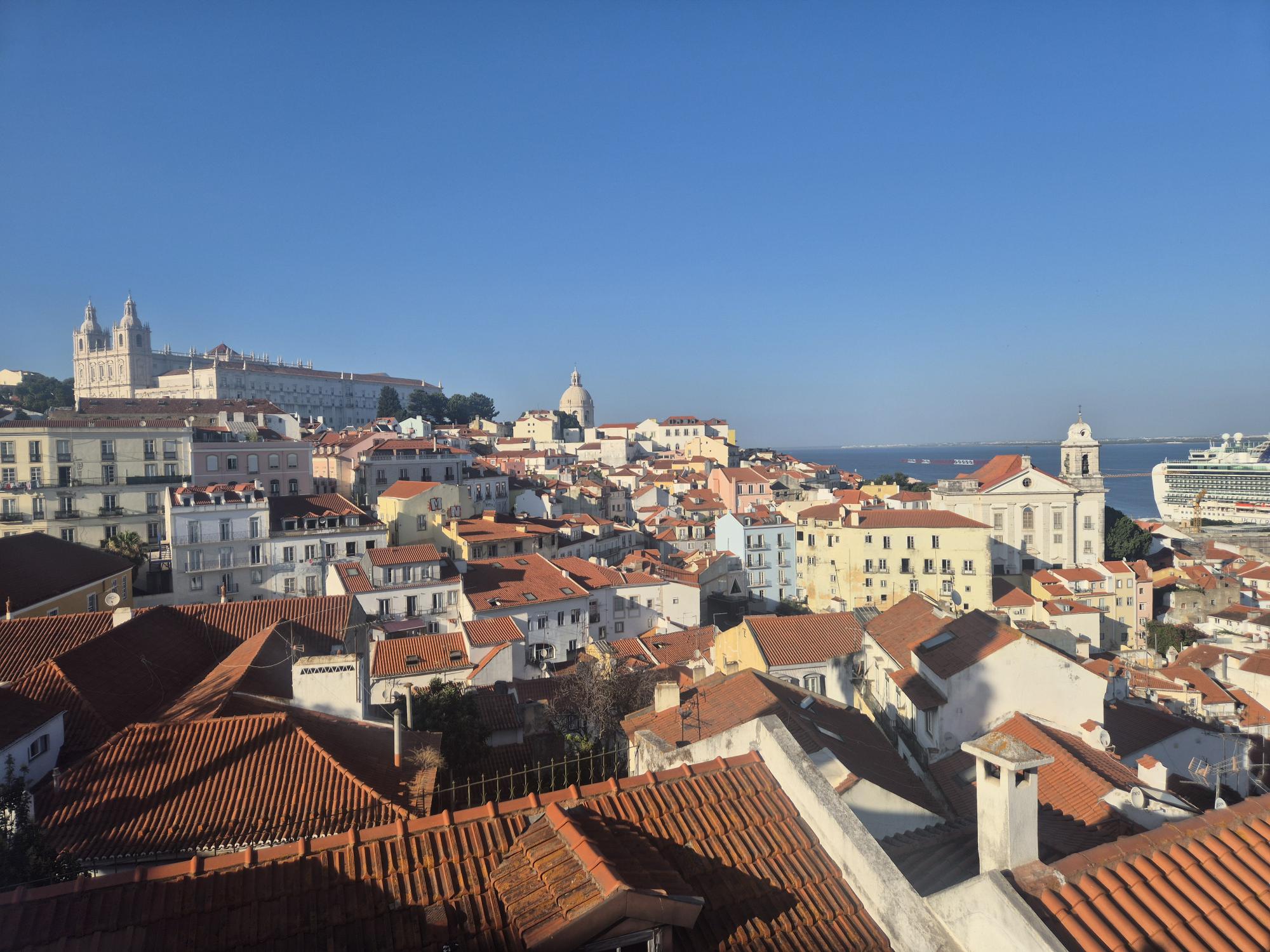
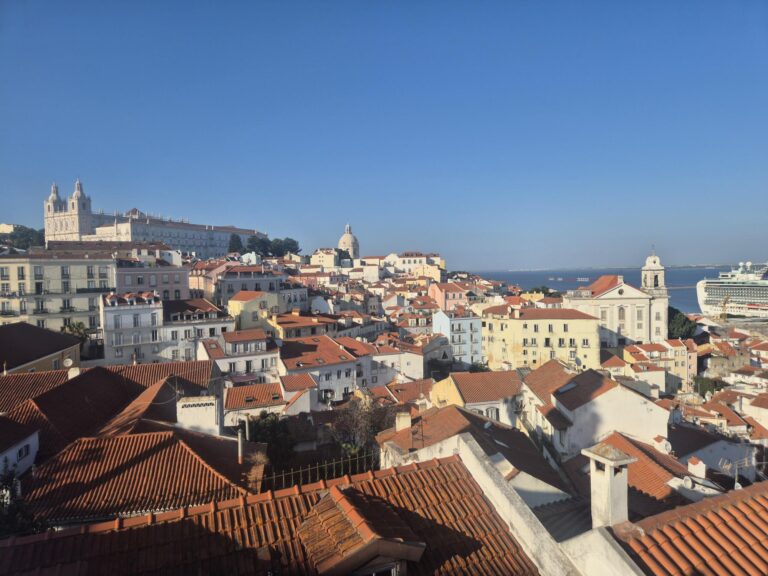
Panoramic view of Lisbon from a miradouro, featuring red-tiled rooftops, the National Pantheon, São Vicente de Fora Church, and a cruise ship by the waterfront.

5 Romantic Miradouro (Viewpoints) to Visit as a Couple In Lisbon
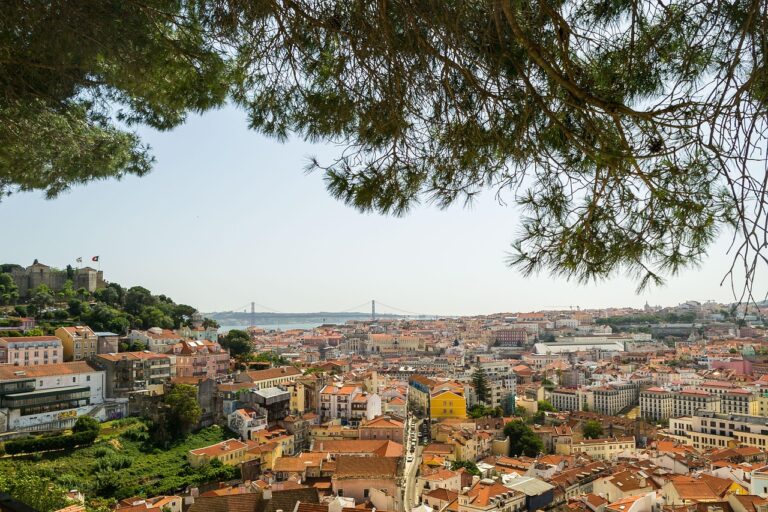
Scenic view from Miradouro da Graça in Lisbon, with red-tiled rooftops, the 25 de Abril Bridge in the background, and tree branches framing the top.

The Magic of Exploring Lisbon as a Couple
Lisbon stands out as a top destination for couples seeking a romantic escape. The city’s old-world charm and breathtaking panoramas set the stage for unforgettable moments with your loved one. Built on seven hills overlooking the Tagus River, Lisbon is filled with miradouros (viewpoints) at every turn. Sharing a sunset view from one of these hilltop perches, with the city’s terracotta rooftops and the river glowing below, is pure magic.
 
Many of these lookouts even come with local musicians serenading visitors, adding a romantic ambiance as you admire the sights of Lisbon together. Picture yourselves wandering hand-in-hand down cobbled streets, past azulejo-tiled buildings and quaint cafés, never knowing when the next turn will reveal a cozy plaza or a stunning vista.
 
Lisbon’s atmosphere practically hums with romance, from the wistful notes of fado music drifting from tavern doors to the golden light that washes over the city at dusk. Whether it’s your first trip or a special anniversary, exploring Lisbon as a couple will feel enchanting and intimate – a journey of discovery you’ll cherish together.
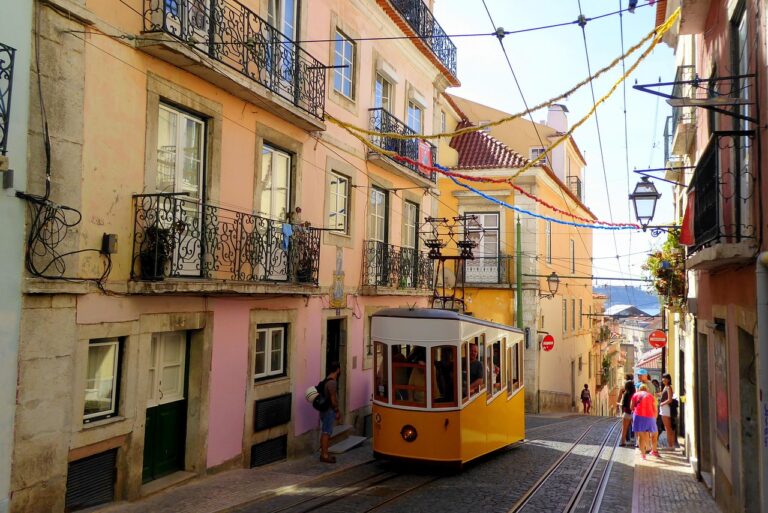
Lisbon’s iconic yellow tram/ funicular traveling up a cobblestone street lined with pastel buildings and colorful streamers.

Miradouro: A Tour of Lisbon’s Best Views

Every miradouro in Lisbon offer a view of the city’s beauty. During our trip, we made it to all the famous downtown viewpoints – each with its own flavor and unforgettable views. Here’s a closer look at five very interesting miradouros (viewpoints) and the special moments they offer:

Topping Lisbon’s tallest hill, this viewpoint rewards you with a 360° panorama over the city. From here you can see the red rooftops of the Baixa downtown, the tagus estuary, and even all the way to the 25 de Abril Bridge and Cristo Rei statue on a clear day. A small white chapel crowns the summit, and legend says it was once a secret haunt for young lovers. Indeed, even today it retains a magical, romantic atmosphere at dusk, despite being more popular now. This was our first moradouro we visited during our trip since it was conveniently located near our hotel Upon Angels, check the hotel review here.

Tip: Tram 28 stops nearby on Rua da Graça, but the final climb up Rua da Senhora do Monte is steep.

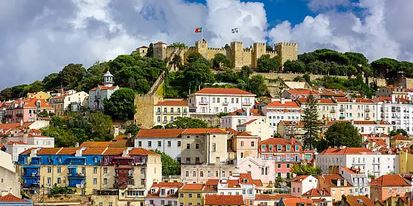
Not far from Senhora do Monte, the Graça viewpoint offers a softer kind of charm. It’s a broad terrace nestled next to the Igreja da Graça, one of Lisbon’s oldest churches, and is beloved by locals and travelers alike. In fact, you’ll often see Lisbon residents meeting up here after work, thanks in part to the kiosk café serving coffee, beer, and pastries right at the viewpoint. Under the shade of big pine trees, you can relax on a bench or at a café table and soak in a splendid view of Castelo de São Jorge perched on a hill to your left.

This castle-and-city panorama – terracotta roofs cascading below the medieval castle walls – has long inspired artists; you might even spot someone sketching the scene. A bronze bust of the poet Sophia de Mello Breyner gazes out over the vista, a tribute to the writer who loved this spot. We found Graça miradouro especially inviting with the scent of pine in the air. It’s the perfect place to catch your breath (and a bica espresso) before continuing your explorations.

🏰 A Day at 3 Sintra Castles, Romantic Palaces, Hidden Paths & Mountain Magic – Life | Travel | Save

  • Miradouro das Portas do Sol (Gateway of the Sun)

    Head downhill into Alfama and you come to perhaps Lisbon’s most iconic lookout. Portas do Sol is essentially one giant balcony overlooking the ancient Alfama neighborhood. Stand at the railing and you’ll see why so many Lisbon postcards are shot from here: below lies a picturesque patchwork of white facades and orange roofs tumbling toward the river, like a Mediterranean village cascading to the waterfront.

    Rising above Alfama’s maze are the distinctive twin bell towers of São Vicente de Fora monastery and the gleaming white dome of the National Pantheon – both clearly visible from this perch. There’s a statue of St. Vincent (Lisbon’s patron saint) welcoming you at the terrace, holding a boat with ravens (the symbol of Lisbon).

    What we loved about Portas do Sol was the energy: street musicians often play here, and a small kiosk café lets you grab a drink or ice cream to enjoy with the view. The name “Gate of the Sun” hints at its orientation – it’s fantastic at sunrise (if you’re up early), but also gorgeous any time on a sunny day, with Alfama’s colors shining bright. If you’d like a seat, there’s also a larger café with a terrace just below the main balcony – perfect for a coffee break with a view.

  • Miradouro de Santa Luzia

    Just around the corner from Portas do Sol is Santa Luzia, a smaller but incredibly romantic terrace that feels like a secret garden in the city. The terrace is draped in bougainvillea vines and features a lovely pergola – stand beneath it and you get a framed view of the Pantheon’s dome and church spires of Alfama through hanging grapevines.

    Along the whitewashed wall of the adjacent Santa Luzia Church (headquarters of the Order of Malta) are beautiful blue-and-white azulejo tile murals: one depicts Lisbon’s Praça do Comércio before the 1755 earthquake, and another shows the Crusaders’ siege of the castle in 1147. Benches line the balustrade, covered in these same traditional tiles.

    Santa Luzia also has a lower level garden: descend the stairs and you’ll find a reflecting pool and more flowerbeds, with another angle on Alfama’s rooftops. This was the only miradouro where we encountered some African street vendors offering ‘free’ bracelets—after a bit of friendly small talk, they try to pressure in to paying for them. Just be aware of this, like in a lot of tourist areas.

  • Miradouro de São Pedro de Alcântara

    Across town in the Bairro Alto district, São Pedro de Alcântara offers a grand vista from the opposite side of Lisbon’s center. This landscaped garden viewpoint is actually two levels: an upper terrace with a wide promenade, and a lower terrace with a formal garden. Right across the valley stands the Castelo de São Jorge on its hill, practically at eye level; you can also see the downtown Baixa grid and the waters of the Tagus off to the side. The upper terrace is paved in classic Portuguese calçada (mosaic cobblestone designs) and lined with busts of Portuguese heroes and mythic figures, giving it a regal feel.

    Kiosk cafés at the miradouro serve beer, sangria, and snacks. Despite being in the heart of a busy quarter, São Pedro de Alcântara felt peaceful and is often dubbed Lisbon’s most romantic hilltop viewpoint.

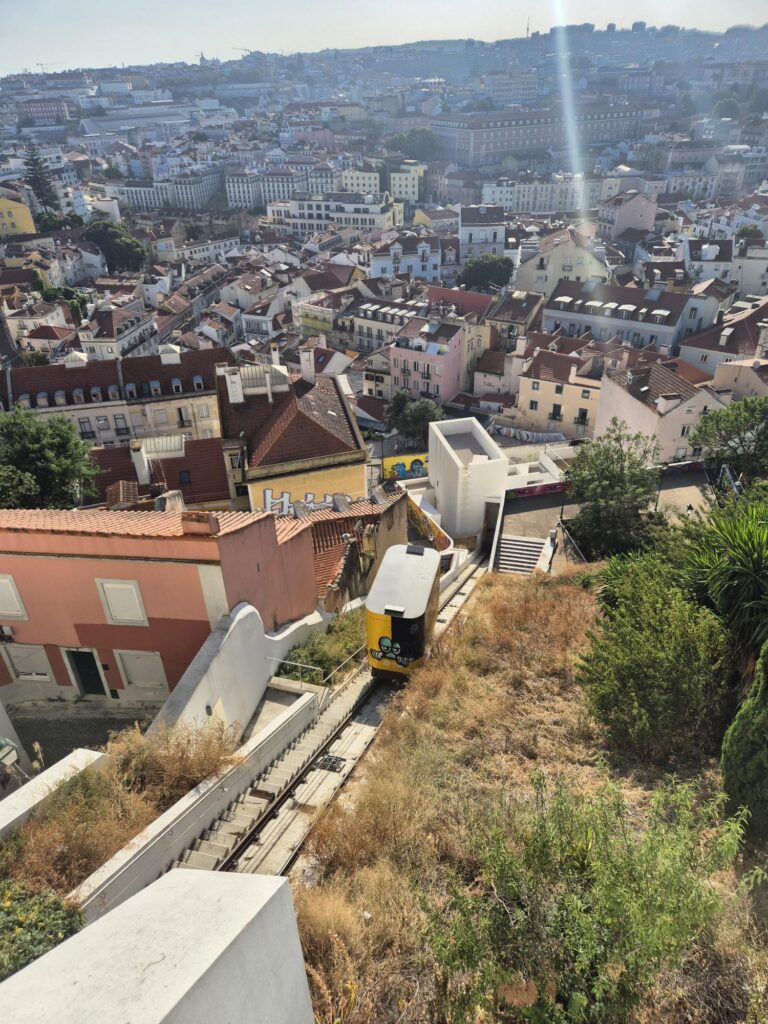
Bonus: Getting here is half the fun. You can ride the historic Elevador da Glória funicular straight up to the miradouro, saving your legs the steep climb. This antique yellow tram on tracks shuttles up and down since 1885, and stepping off at the top by the garden makes you feel like you’ve traveled back in time.
Each of these miradouros gave us a different angle of Lisbon – literally and figuratively. From the fiery sunset at Senhora do Monte to the morning glow over Alfama at Portas do Sol, we found that stringing together multiple viewpoints in our day was a wonderful way to explore the city. And best of all, they’re free to visit and linger as long as you like. Don’t forget to take some couple selfies with those amazing backdrops!
Yellow and white funicular ascending a track lined with greenery and buildings, heading toward a miradouro (viewpoint) in Lisbon.

Scenic Strolls & Cafés: Charm Around Every Corner

There’s nothing like slowly wandering Lisbon’s scenic streets and pausing at cute cafés along the way. In between miradouros, we often found ourselves strolling through the labyrinthine lanes of old neighborhoods like Alfama and Bairro Alto, soaking up the atmosphere. Be warned: Lisbon is renowned for its steep streets – you never know when the next corner will reveal an uphill climb that takes your breath away (figuratively and literally!).
 
The city’s many stairs and inclines can indeed be a workout, so wear comfy shoes and take your time. Some steps can also be quite slippery, so be careful. We quickly learned that while the hills can put a bit of a burn in your legs, the rewards are totally worth it – every climb unveils another charming alley or a hidden gem of a view, and the gorgeous cobbled streets themselves are part of Lisbon’s romance.
 
One of our favorite walks was from the Alfama viewpoints down into the neighborhood’s heart. From Portas do Sol, a staircase leads you directly into Alfama’s postcard-pretty maze of streets. Around every bend was a new discovery: a tiny tiled chapel, a doorway where you could buy beautiful drinks (Pina Colada) inside a real pineapple, or a wall covered in colorful street art. In Alfama, you’ll find plenty of little family-run taverns and coffee shops tucked in the corners of squares. Don’t hesitate to take a seat at an outdoor table and do some people-watching.
 
Tip: try a fresh local pastry during your stroll and take them with you to a miradouro. The famous pastel de nata (custard tart) is a must – and trust me, it tastes even better when shared with someone special! We savored one (or more) every single day together at different famous cafe´s (with flaky crust and cinnamon on top), and it was heaven in a bite. Reminded me of Finnish christmas (rice) porridge with a bit of sugar and cinnamon on top.
 
Over in the Bairro Alto and Chiado area, the vibe is different but equally delightful. Streets are a bit wider, lined with trendy boutiques, azulejo-fronted shops, and historic cafes. In Bairro Alto’s upper lanes, by day it’s quiet, with residents chatting by doorways and graffiti murals adding color to the old buildings. By late afternoon, the neighborhood comes alive with cafés and “tascas” (taverns) opening up.
 
Another charming walk is through the Mouraria neighborhood (just below the castle), where multicultural shops and street art pay homage to Fado’s roots. Everywhere we walked, the pattern was the same: steep climbs balanced by rewarding scenes and often a delightful café at the top or bottom.
 
Practical note: If the hills ever feel like too much, remember you have options. Lisbon’s streets may be challenging, especially if you have mobility issues, but help is easy to find. Fleets of electric tuk-tuks zip up and down the hilly lanes – we saw them constantly ferrying visitors to the top of viewpoints that would be a tough slog on foot. These three-wheeled taxis are a fun (if bumpy) way to give your legs a rest.
 
Of course, you can always call a regular taxi or an Uber/Bolt ride to get you where you need to go. We used a ride-sharing app a few times in Lisbon and during our daytrips without any problems. It was quick, affordable, and saved us some energy. Public transport can assist too: Lisbon’s vintage trams and funiculars are not only charming but also purposely built to tackle the steep routes (the Elevador da Glória and Elevador da Bica are essentially very short tram lines that crawl up near-vertical streets!). However you choose to get around, don’t let the hills deter you – the vistas and cozy streets you’ll discover are more than worth the workout.
 
And sometimes, slowing down is the whole point. Take breaks, enjoy the surroundings. Lisbon’s café culture is strong – from sun-dappled esplanades (outdoor terraces) to standing-room coffee bars where locals down an espresso in two sips. As a couple, we found these little pauses — sipping a drink under a jacaranda tree or sharing a pastry on a bench — just as romantic as the “big” experiences. So intersperse your sightseeing with leisure: an afternoon café stop or a leisurely stroll through a garden can be a delightful way to connect and create memories together.

Bonus Tip: Romantic Tram Ride & a Hidden Gem
For a touch of vintage romance, hop on Lisbon’s iconic Tram 28. There’s a reason this rattling yellow tram is so famous – its route winds through the prettiest historic neighborhoods, giving you a rolling tour of Lisbon’s highlights in one unforgettable ride. Creaking and clanging, Tram 28 will carry you both up and down the city’s hills, from the narrow streets of Alfama through downtown, up to Chiado and Estrela. It’s like a moving time machine, passing by landmarks like the Lisbon Cathedral and viewpoints such as Portas do Sol and Graça along the way.
 
Admittedly, Tram 28 is no secret – it’s often filled with other sightseers, so you may not get that private moment while onboard. During our visit the tram stops were packed with tourists and the tram itself was completely full of people standing. We decided to skip this tram adventure because of this. Noteably the trams do not have any air conditioning, except for the open windows. The metro on the other hand has a slight air conditioning system, but it does not help much when it is +30 degrees during the day.
 
Alternatively, if you are the type to seek out hidden spots away from the tourist trail, Lisbon has plenty of secret corners. One unexpected (miradouro) gem we recommend is the Miradouro de Santo Amaro, a lesser-known viewpoint that offers its own quiet magic. Tucked in the Alcântara district (a bit outside the usual route), this tiny terrace by a small white chapel rewards the journey with a splendid view of the 25 de Abril Bridge and the river. It’s far from the crowds, so you might find yourselves alone or with just a couple of locals enjoying a sunset here.
 
In summary, Lisbon enchanted us with its mix of breathtaking views, charming strolls, and intimate experiences. It’s a city that invites you to slow down and savor the sights, sounds, and flavors – together. Whether you’re watching the sun dip below the horizon from a miradouro, clinking glasses at a café to eating some delicious pastel de nata, or trundling through ancient streets on a rattling tram, the magic of exploring Lisbon as a couple is real and profound. We left with our hearts full and already dreaming of our next Lisbon adventure, hand in hand. Até logo – see you soon, Lisbon! 
Panoramic view of Lisbon from a miradouro, featuring red-tiled rooftops, the National Pantheon, São Vicente de Fora Church, and a cruise ship by the waterfront.

This post has been enhanced using AI for text improvement.


Discover more from Life | Travel | Save

Subscribe to get the latest posts sent to your email.